

Since the invention of the two-faced pallet by George Raymond, Sr. so that it facilitated handling by hydraulic hand pallet trucks way back in 1939, there has been steady and significant progress in improving material handling. Some examples of these improvements are below:

- Higher storage density, both by way of narrower aisles and greater lift height
- More reliable equipment
- Faster speeds for greater throughput
- Automation integrated in the truck to reduce the FTE costs
Very Narrow Aisle Versatility
Today, very narrow aisle (VNA) applications are typically 72” wide and either rail or wire guided. We won’t discuss non-guided vehicles here because their productivity is much lower than guided vehicles. Guided pallet handling VNA operators sit in a cab that elevates with the forks to provide the best visual of the fork/pallet interaction at height.
Wire Guided
- Raymond 9600 swing-reach turret truck handles loads up to 33-ft. with a capacity of 3,000 lbs.
- Raymond 9700 swing-reach truck handles loads up to 43-ft. with a capacity of 3,000 lbs.
- Raymond 9800 swing-reach truck handles loads up to 50-ft. with a capacity of 3,300 lbs.
Rail Guided
- TRT Transtacker lifts loads up to 65-ft high, and can handle up to 4,000 lbs. without downrating or slowing down at full elevation- a real compelling alternative in the world of VNA.
- Guided order picking operators stand on the platform and elevate with the forks for case in/case out operations to heights up to 33 feet.
Guiding Operators to Greater Productivity
Let’s focus on the most popular pallet in/pallet out and pallet in/case out units. These units have heights up to
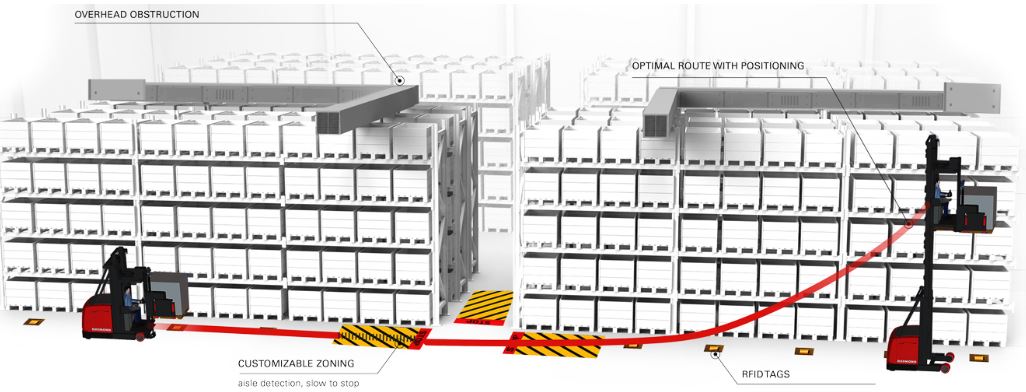
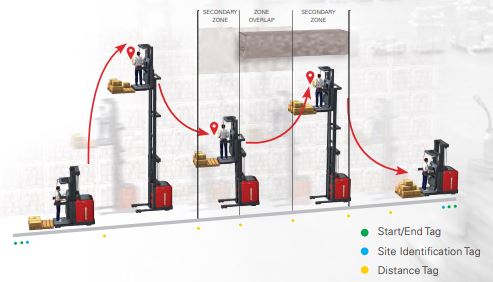
43-ft. and the latest in operator productivity enhancements designed to reduce FTE costs. Every pallet-handling job requires several steps in the process. Operators must either read pick tickets or interact with WMS software via handhelds or truck-mounted computers, plus concentrate on driving and lifting from one location to the next. As swing-reach turret trucks elevate, speed is reduced for safety reasons. An operator moving from one elevated location to another has the choice of lowering to the floor to get full speed or travelling at height to eliminate the time required to lower and lift again.With Zoning and Positioning (ZaP), you’ll take the guesswork out of the most productive vectoring to minimize the time between locations so the operator is freed up to perform other tasks during the travel process. Interacting with your warehouse management software will be like having an on-board assistant to do all the driving.
Additional benefits include warehouse awareness for overhead obstructions and intersecting aisles. Sounds great, doesn’t it? If ergonomics is important to your company, a little-known feature available from Raymond brings the forks of a standard order picker to waist height.
The future is here, and we can help tap into it. Contact Abel Womack today and let’s talk about storage density, picking styles, and productivity so you can run better and manage smarter.
 43-ft. and the latest in operator productivity enhancements designed to reduce FTE costs. Every pallet-handling job requires several steps in the process. Operators must either read pick tickets or interact with

Leave a Reply
You must be logged in to post a comment.