

A conveyor system doesn’t have to be completely broken to drag down productivity. Sometimes the signs are more subtle. Cartons back up at packing, employees walk product across the floor, or order volume keeps outpacing your current setup. If any of these issues sound familiar, it may be time to take a closer look at whether your conveyor is still aligned with your current operation.
Roller, belted or sortation conveyors: How to decide which one is right for your operation?

Before comparing equipment options, look at the entire process. The right conveyor choice starts with answering these questions: what are you moving, how quickly does it need to move, where is it going, where are the bottlenecks happening today, what controls and flexibility do you need, what packaging challenges do you have, what needs to change as volume grows, and what is the total cost of ownership.
Start with the product: What are you moving?
Before choosing between roller conveyor, belted conveyor, or sortation conveyors, look at:
- Product size and weight
- Bottom surface condition: flat, soft, uneven, rigid
- Packaging type: cartons, totes, pallets, polybags, loose parts
- Product stability
- Fragility or damage risk
- Required throughput
- Space constraints: layout, aisle widths, dock positions, mezzanines, future expansions
- Whether items need to accumulate, incline, decline, or divert
 You can minimize product damage and handling issues when comparing roller conveyors versus belted conveyors. Keep in mind that a rigid carton behaves very differently than a polybag. A tote with a flat bottom moves differently than an uneven package or loose component. Pallets, heavy loads, and dense products also bring their own requirements for frame strength, drive type, transfers, and safety.
When roller conveyors make good sense
Roller conveyors are often a strong fit when you are moving products with firm, flat bottoms like:
- Cartons
- Totes
- Cases
- Pallets, depending on configuration
- Straightforward transport and accumulation

They can be powered or gravity-fed, making them a flexible option for shipping, receiving, assembly, picking, and staging areas.
One reason roller conveyors are so common in warehouses is that they support straightforward product flow and can be easily expanded or reconfigured as operations change. Powered roller conveyors can also support accumulation, allowing cartons or totes to queue before scanning, picking, packing, or sorting without creating constant downstream back pressure.
Roller conveyors are not ideal for:
- Small loose items
- Soft packaging or uneven bottoms
- Polybags
- Products that can catch, sag, or fail to track properly between rollers
When a belted conveyor is the better choice
- Belted conveyors can provide a continuous surface to keep product moving smoothly when you need:
- More product support during transport
- Better control on inclines or declines
- Smooth movement for loose parts, small packages or irregular shapes
- Reduced risk of product catching between rollers
- More consistent handling of mixed packaging
Belted conveyors are also commonly used on inclines and declines because the belt provides greater surface contact and helps reduce product sliding during elevation changes. For operations dealing with mixed package types, packaging variability, or fragile items, that added control can make a noticeable difference.
When a sortation conveyor enters the conversation
Sortation conveyors matter when the challenge isn’t just movement, it is routing. You may be ready for a sortation conveyor if:
- Order volume increases are hard to manage
- Packing or shipping lanes are backing up
- SKU counts expand or order profiles become more complex
- Fulfillment expectations increase
- Manual sorting becomes a bottleneck
- You are adding labor to keep product moving
A sortation system helps direct cartons, totes, cases, or polybags to the right destination with greater speed and consistency.
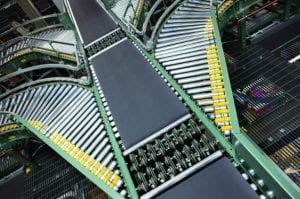
When sortation conveyors are the right fit
- Route products to different lanes, zones, dock doors, or work areas
- Support a range of product types, including cartons, totes, and polybags
- Help maintain consistent throughput in high-volume fulfillment environments
- Reduce reliance on manual decision-making and manual product movement
- Accommodate low-, medium-, or high-throughput applications depending on the selected technology
Common sortation technologies include:
- Sliding-shoe
- Narrow-belt
- Cross-belt
- Tilt-tray systems
The right choice depends on factors such as product size and weight, required sort rates, available space, divert accuracy, budget, and integration with upstream and downstream processes.
Look beyond equipment cost

It’s tempting to make a conveyor decision based mainly on upfront cost. But with conveyors, the better question is what will the system cost or save over time? Maintenance requirements, energy use, operator involvement, scalability, product damage, downtime, and return on investment all affect the system’s value. A lower cost option may work perfectly in one area but create bigger problems elsewhere.
For example, a gravity roller section may be all you need for a simple staging area, while a powered roller system may be a better investment for controlled accumulation. A belt conveyor may solve issues with unstable or inconsistent packaging, and in higher-volume operations, sortation may keep product moving more consistently without adding more labor as volume increases. The best choice is not always the lowest-cost option. It’s the one that supports the way your operation works today and takes it where it needs to go next.
The bottom line
No one-size-fits-all conveyor fits every warehouse. Roller conveyors, belted conveyors, and sortation conveyors each solve distinct material-handling challenges. The best system is the one designed around your products, throughput goals, facility layout, and long-term operational needs.
If conveyor bottlenecks are slowing down your fulfillment or limiting throughput, now is the time to take a closer look at your product flow. Abel Womack can evaluate your current process, product mix, space constraints, and throughput goals to identify the conveyor system that best fits your operation.


About the Author: Peter Blangiardi
As an Automated Solutions Sales Engineer, Peter Blangiardi works with clients and vendor partners to design and implement conveyor-focused automation solutions that improve material flow, increase productivity, and support more efficient warehousing and manufacturing operations.
Recent Posts
September 22, 2026
September 8, 2026
August 11, 2026
Stay Updated!
Join our mailing list to receive blog posts from Abel Womack.
