

If your team is picking from floor-level locations while unused vertical space sits overhead, you may be closer to added capacity than you think. For many warehouse and operations managers, the challenge is familiar: order volume is increasing, labor is stretched, pick paths are getting longer, and expanding the building is not always realistic. A multi-level pick module can help turn that unused cube into productive storage and picking space without requiring a major facility expansion or a full automation project.
What is a Pick Module
A pick module is more than a rack-supported platform. When done well, it is a planned picking environment that combines storage, access, replenishment, product flow, safety, and future scalability into one coordinated system. In the right application, it can offer excellent ROI while improving efficiency and space utilization.
After installing many multi-level pick modules in real warehouse environments, one thing has become clear to me: the best systems are not always the most complicated ones. They are designed around the customer’s SKU mix, picking activity, replenishment process, building constraints, and growth plans.
Pick Module Advantages:
The biggest advantage, and most obvious, is the improvement in space efficiency. Many pick operations take place at floor level only, with the picker accessing product up to about 6 feet. This negates the need for any powered equipment or rolling ladders but also limits the number of pick faces and often leaves a vast amount of unused overhead space. The multi-level pick module expands that pick area upward, vastly improving space utilization.
Furthermore, pick modules offer:
- Increased storage and picking capacity
- Improved order fulfillment efficiency
- Better inventory organization
- Reduced facility expansion costs
- Integration with conveyors and automation systems
- Scalability to accommodate future growth
- Simplistic design
When Multi-Level Pick Modules Makes Sense
A multi-level pick module may be a strong fit when your operation needs more usable pick faces, better organization, or a way to increase capacity without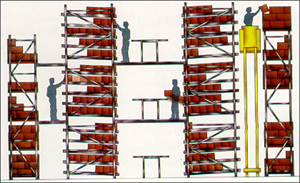 expanding the building footprint. It’s especially worth considering when:
- You have unused vertical space but limited floor space.
- Pickers spend too much time walking between locations.
- You need more pick faces for growing SKU counts or order volume.
- Your team handles a mix of each-pick, case-pick, or slower- and faster-moving products.
- You want to separate forklift replenishment activity from pedestrian picking areas.
- You need a solution that can work with conveyors, carton flow, pallet flow, or future automation.
How a Pick Module is Designed
Multi-level pick modules, also called rack-supported mezzanines, are constructed from pallet racking components, which makes design and assembly reasonably simple. Picture a pallet racking system with two rows of racking on the left and right, with a travel aisle between them. We connect the two rows of racking with ‘shelf’ beams that span the aisle. These beams now serve as our floor supports, and we add decking to them, guardrails, and access stairs.
Now, a person picking goods can access the lower portion of the racking from the floor, and products in the upper locations can be accessed from the mezzanine level without powered equipment!
When It May Not Be the Right Fit
A pick module is not automatically the right answer for every warehouse. If order volume is low, SKU movement is unpredictable, ceiling height is limited, or replenishment cannot keep up with picking activity, a simpler storage layout, or a different picking strategy may be a better first step. The key is to look beyond storage capacity alone and consider how products, people, equipment, and orders move through your operation.
Common Mistakes to Avoid
One of the biggest mistakes companies make is viewing a pick module as simply a way to add more storage. Capacity matters, but the real value comes from designing a system that supports how orders are picked, replenished, packed, and moved through the facility. Before committing to a layout, take time to think through these common issues:
- Designing for today only. A layout that fits current inventory may fall short if SKU counts, order volume, or customer requirements change.
- Underestimating replenishment. If product cannot be replenished efficiently, pickers may still experience delays, even with more pick faces available.
- Focusing only on storage density. More locations do not automatically mean better productivity if travel paths, product flow, and pick sequencing are not considered.
- Overlooking safety and building requirements. Stairs, guardrails, lighting, sprinkler coverage, egress, load capacity, and forklift traffic patterns all need to be part of the planning process.
- Treating conveyors or automation as an afterthought. Even if automation is not part of the initial project, it is smart to consider whether the system may need to support conveyors, carton flow, or other technologies later.
- Skipping a detailed SKU and order profile review. The best pick module designs are based on actual product movement, not assumptions about what should go where.
Multi-Level Pick Module FAQs: Common Misconceptions Answered
Are multi-level pick modules only for large e-commerce operations?
Not necessarily. A multi-level pick module can benefit any warehouse that needs more pick faces, better product organization, or a smarter way to use vertical space. While they are common in high-SKU and high-volume operations, the right fit depends more on whether the layout supports your order profile, SKU movement, available clear height, and growth plans than company size.
Will a multi-level pick module automatically improve productivity?
Not by itself. A multi-level pick module can improve productivity when designed properly, but the structure alone does not do the work. The real gains come from proper slotting, replenishment, clear pick paths, and product flow. If those pieces are not planned up front, you may add capacity without solving the real bottleneck.
Does warehouse automation replace the need for pick module planning?
Automation works best when it is added to a well-designed picking environment. In many cases, conveyors, carton flow, pick-to-light, or other technologies are more effective when the multi-level pic module layout is designed around product movement, order volume, and future scalability. Planning the pick module correctly also gives you a better foundation for automation later.
Is the main benefit of a multi-level pick module storage density?
Storage density is one benefit, but it is not the only one. A well-designed multi-level pick module can also reduce travel time, improve product flow, separate pedestrian picking areas from forklift traffic, and create a more consistent order fulfillment process. In other words, the goal is not just to fit more product into the building, it is to help the operation run better.
Is a Pick Module Right for Your Operation?
The right pick module should do more than add storage. It should improve how work flows through the warehouse. When designed around SKU activity, replenishment needs, pick paths, safety requirements, and future growth, multi-level pick modules can be a practical way to increase capacity and productivity without immediately expanding the building or jumping into a more complex automation project. The best first step is to look closely at how your operation works today, where the bottlenecks are, and where it needs to go next.

About the Author: Jim Mihachik
Jim Mihachik is an Account Manager covering New Hampshire and Vermont. He brings more than 25 years of experience in material handling equipment sales and service.
Recent Posts
September 22, 2026
September 8, 2026
August 11, 2026
Stay Updated!
Join our mailing list to receive blog posts from Abel Womack.
